I love Julia Roberts. I love everything about her and everything she’s ever done. Many would say Pretty Woman or My Best Friend’s Wedding is her magnum opus, but if you’re my mom, it’s Notting Hill. For me, it’s Steven Soderbergh’s Erin Brockovich. Roberts plays a young, super broke, down-on-her-luck mother known as Erin Brockovich. As a biographical film, the movie dramatizes Brockovich’s fight against Pacific Gas & Electric Company’s (PG&E) involvement in water contamination in Hinkley, California. She’s a stubborn, hardcore, at times over-the-top, and determined woman who was involved in a car wreck where a doctor slammed into her. She tries to sue and is told her case is a simple win, but when it’s suggested in court that she’s a bad mother, her defensive behavior displeases the jury. Brockovich strong-arms her lawyer into hiring her as a legal clerk following the loss of her case.

While organizing files on a PG&E real estate case, she feels that something is off and visits the woman, Donna Jensen, whose land PG&E is attempting to purchase. After their conversation, she pieces together that there is a massive issue with the town’s water, and residents have been getting egregiously sick while PG&E attempts to cover their tracks. Hexavalent Chromium is the culprit, from the hands of the folks at PG&E who knowingly contaminated the water supply and told residents it was safe to drink. Hexavalent Chromium is extremely harmful, people are dying, Brockovich is fired up, PG&E sucks, everything that could go wrong does, and my god; it’s a great story. I believe it is a perfect film to consider when asking ourselves: How do we make people care about environmental stories?

“By the way, we had that water brought in specially for you folks. Came from a well in Hinkley.” Brockovich says this to lawyers from PG&E who make the mistake of immediately pissing her off during a meeting by suggesting Hinkley’s people are lesser. The lawyers offer a blurry settlement that doesn’t truly acknowledge any wrongdoings and barely compensates plaintiffs. Brockovich goes directly into a tirade on the PG&E team, using lewd language, an aggressive tone, and a quickness that startles. One of the pretentious lawyers picks up a glass of water and is met with Brockovich’s quote above. You can feel the power through the screen. The air in the room stills, and stomachs certainly drop. Brockovich doesn’t falter, not even for a second. The lawyer looks wary and angrily defeated as she puts the cup down without drinking and quickly ends the meeting. An admission of guilt that burns the fire brighter in Brockovich to charge on and fight for the people of her town. They know that she knows the truth and is not going to roll over easily.
In another scene, Brockovich provides the prosecution with an invaluable six hundred and thirty-four signed documents from plaintiffs, an exhaustive feat, so that they can thwart PG&E’s attempts at drawing the case out. The entire team is astonished. Nobody believed in her for most of the movie, and everyone judged Brockovich because of her social status, looks, and personality. Now, she is the reason the case can move forward with success. She spent her days laboriously visiting every person who could be a plaintiff, hearing their heartbreaking health stories, and feeling the weight of their pain. One of the lawyers asks how she did this. She responds, “Well, seeing as I have no brains or legal expertise, and Ed here was losing all faith in the system, I just went out there and performed sexual favors. 634 blowjobs in five days. I’m really quite tired”. Her deadpan, straight-up response perfectly encapsulates Robert’s commitment to this role. You know Julia Roberts is a big actress, and you’ve probably seen her in other projects, yet she is Erin Brockovich. When you watch these scenes, it feels like Roberts is playing herself. There is no debate, question, or belief that this is anyone except Erin Brockovich in front of your eyes. It sure as hell isn’t Julia Roberts.
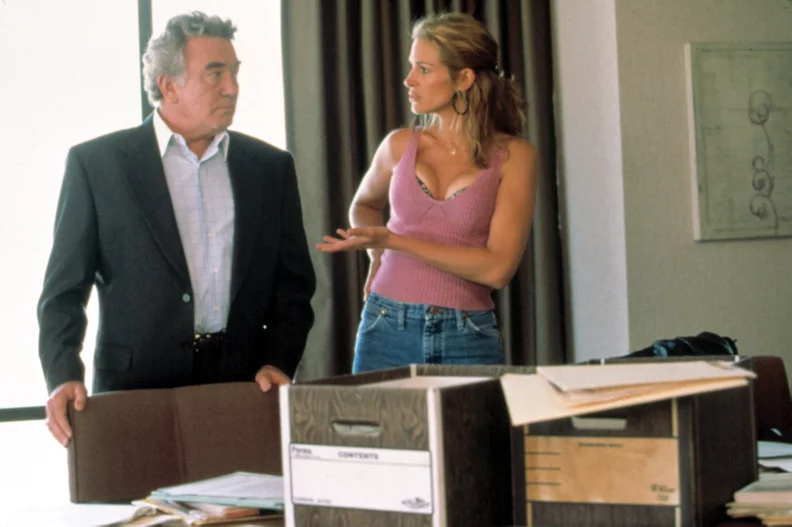
Julia Robert’s Erin Brockovich is difficult to be around. She stresses you out, is frequently aggressive with others, and never accepts a “no”. At times, we want to hug her, and at times, we want to shake her and shout in her face. But we like her anyway. We like her because she takes us on this tumultuous journey of justice for the underdog and “sticks it to the man” at every opportunity. The audience doesn’t have to care about water contamination in Hinkley, California. They don’t have to care about this at all, even knowing it’s a real-life story. Julia Robert’s Erin Brockovich makes us care; we have no choice but to buy in and watch her story unfold. The movie intentionally stays away from politics because, to Brockovich, nothing about this story is political. The story is about the people of Hinkley. The town is poor, and their water is poor, yet the people are good. The people are deserving of safe drinking water, and they shouldn’t be lied to by a corporation just because they are nearly powerless. One of the differences between Brockovich and other characters is that she focuses all of her work on social outreach. She is the one who is going out and talking to the citizens of Hinkley to get their stories. She memorizes every single plaintiff’s name, number, and account of what happened to them. At the beginning of the movie, Brockovich says, “I just want to be a good mom. A nice person. A decent citizen. I just want to take good care of my kids, ya know?”. This line ends up being the theme of all those in Hinckley whom she speaks to. All the plaintiffs want is to be good and decent, not sick. The moments onscreen where we see Brockovich interacting with townspeople are unbelievably emotional, and her character feels it, too. She is one of them, and she engages with them as such. She speaks to them on their level because that is where she exists, too. She bears the burden of these stories and has to channel it into rageful action to try and find some justice. All the while, we as the audience care. Julia Robert’s performance is so captivating and grounded that we don’t see an actress; we see a trailblazer.

In one of the final scenes, Brockovich pays another visit to Donna Jensen, the first person she spoke to about the case. Jensen and her family have been incredibly sick throughout the whole movie, with Brockovich doing everything she can to help for the past two years. At this moment, Brockovich comes with words of relief. PG&E is going to pay everyone. And they’re paying everyone well. The Jensen family will also receive five million dollars for their extreme troubles. This is the moment the entire movie was made for. Jensen is finally able to breathe and gain some justice for what happened to her family. Brockovich is now unburdened by the weight of making this happen. Everything she did for two painstaking years was for this moment, and it is reflected in Robert’s performance. We have seen Brockovich smile before, sure, but now we see her face light up. She looks softer here; she isn’t angry, and she is finally able to bask in the reward of her work and relax for a minute. With this scene, we once again, care.
If what makes us care about a very real water contamination crisis thirty years ago in a middle-of-nowhere broke town is a ferocious, unabashed, and rough-around-the-edges woman played by one Julia Roberts, then maybe we should be doing more of that and less of whatever is happening today.
All images sourced from Google Images.
 nowinmyopinion
what do you think